


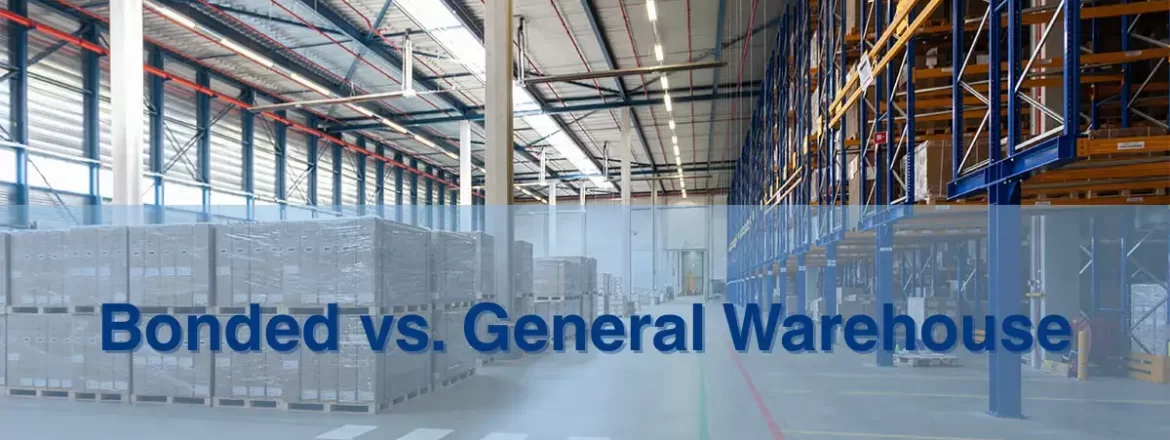
Bonded warehouse vs. general warehouse in Vietnam: Which is right for your supply chain?
As Vietnam rapidly cements its position as a global manufacturing hub, efficient supply chain management goes beyond just moving goods quickly-it’s about cost optimization. For Logistics Managers and FDI business owners, one of the biggest bottlenecks affecting direct cash flow is the burden of Import Duties and VAT.
Are you torn between choosing a Bonded Warehouse or a General Warehouse? A wrong decision here can result in billions of VND in capital being tied up in taxes while inventory sits idle. This article by Fastrans breaks down the core differences between these two models from a financial and customs perspective, helping you make the smartest decision for your supply chain.
Redefining the basics: general warehouse vs. bonded warehouse
General Warehouse
This is the most common storage model. Goods stored here are considered to have completed customs clearance (for imports) or are domestically produced goods.
- Legal Status: Goods are deemed to have entered the domestic market.
- Tax Obligation: Businesses MUST settle all Import Duties and Value Added Tax (VAT) before the goods can be moved into this warehouse.
Bonded Warehouse
Under current regulations, a Bonded Warehouse is a separated area within Vietnam’s territory but is legally considered a “non-tariff zone.”
- Legal Status: Goods are not yet considered to have formally entered the Vietnamese domestic market. They remain under the direct supervision of Customs.
- Tax Obligation: Businesses DO NOT have to pay Import Duties or VAT as long as the goods remain within the bonded area.
Strategies for tax & cash flow optimization
This is the heart of the matter. Why do multinational corporations often prioritize Bonded Warehouses in their Supply Chain strategy?
Tax Suspension – The Cash Flow Lifesaver
When you import a large shipment into a General Warehouse, you must pay 100% of the taxes immediately upon arrival. If that inventory sits for 6 months before being sold, you essentially have a massive amount of capital “dead” for half a year in the form of paid taxes.
With a Bonded Warehouse, you leverage the Tax Suspension mechanism:
- Pay only when necessary: You can import 10 containers into a bonded warehouse, but if you only need to sell 1 container domestically this month, you only open a declaration and pay taxes for that specific container.
- Benefit: Cash flow is freed up for reinvestment in production or marketing instead of being tied up.
Optimizing for Re-export
If your business uses Vietnam as a distribution Hub for third countries (like Laos, Cambodia, or transshipping to the US/EU):
- General Warehouse: You pay tax upon entry, then go through a complex Duty Drawback process upon export. This is administratively burdensome and delays capital recovery.
- Bonded Warehouse: You pay ZERO import tax from the start. Goods re-exported from a bonded warehouse are exempt from duties. This simplifies procedures, reduces lead time, and eliminates administrative costs.
Comparison at a glance
| Criteria | General Warehouse | Bonded Warehouse |
| Import Duty & VAT | Pay immediately upon port arrival | Suspended (Only pay when importing to domestic market) |
| Customs Procedures | Must clear customs before storage | Declare bonded transport (OMA), subject to supervision |
| Storage Duration | Unlimited | Max 12 months (extendable by another 12 months) |
| Cargo Handling | Flexible (re-packing, manufacturing, etc.) | Restricted (reinforcing, labeling, re-packing only…) |
| Rental Cost | Generally lower | Generally higher (due to supervision & infrastructure fees) |
| Best For | FMCG, High turnover domestic goods | Raw materials, price speculation, transit/re-export goods |
Common questions
Can I process or manufacture goods inside a Bonded Warehouse?
Not fully. According to Decree 08/2015/ND-CP, you are not allowed to perform manufacturing or processing that changes the HS Code of the goods.
However, you are allowed to perform value-added services such as:
– Reinforcing packaging, re-packing.
– Sorting and maintenance of goods.
– Taking samples for management or customs purposes.
– Transferring ownership of goods.
How long can I keep goods in a Bonded Warehouse?
Under current regulations, the maximum storage time is 12 months. In valid cases, the Director of the Customs Department may grant a one-time extension of no more than 12 months. This totals a maximum of 24 months-sufficient time to find buyers or wait for better market prices.
Can I sell goods from a Bonded Warehouse directly to a Vietnamese customer?
Yes. Domestic customers can import directly from your bonded warehouse. The buyer will open an import declaration and pay taxes just as if they were importing from overseas. Ownership transfer procedures can be done right at the warehouse
Is the inbound process for Bonded Warehouses complicated?
It requires stricter documentation. At Fastrans, we apply a rigorous SOP :
– Check Pre-alert: Invoice and Packing List must be 100% accurate before arrival. Even minor discrepancies can cause Customs to reject the bonding request.
– Transit Declaration: We must file a On-Board/ Local Arrangement or Open License Agreement declaration (OLA) to move goods from the port/airport to the bonded warehouse under customs seal and supervision.
Which is right for your supply chain?
The choice depends entirely on your business model:
- Choose a General Warehouse if: Your goods have high turnover, you have confirmed domestic orders, and you simply want to minimize storage rental costs.
- Choose a Bonded Warehouse if: You are an FDI enterprise needing to stockpile raw materials, a trading company importing in bulk to wait for better pricing, or a business handling temporary import for re-export.
At Fastrans, we don’t just provide services; we provide solutions:
- Consultancy: We conduct a Cost-Benefit Analysis to see if the tax savings outweigh the potentially higher bonded storage fees.
- Seamless Integration: With our experience handling thousands of Air/Sea Export & Import shipments, we ensure a smooth transition from the moment cargo leaves the origin port (Booking, Docs Check) until it is safely stored in Vietnam. Our Docs & CS team monitors every shipment to resolve issues (like damages or discrepancies) instantly (Standard Lead time for issue feedback < 30 mins).
Still unsure about the customs procedures for Bonded Warehouses? Contact Fastrans today for a free consultation on HS Codes and tax optimization strategies for your upcoming shipments.
Fastrans – Logistics Partner You Can Trust.