


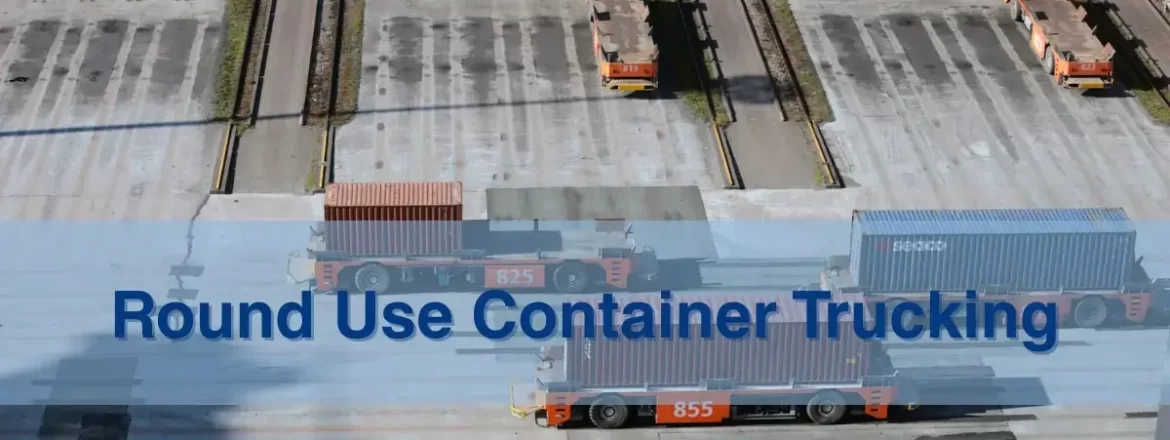
What is Round Use Container Trucking? The Street Turn Strategy for Logistics Savings
In the high-pressure world of global supply chain management, where freight rates fluctuate daily and operational costs constantly eat into profit margins, Logistics Directors and Import-Export Managers are in a perpetual search for optimization. Every dollar saved in domestic transportation contributes directly to the bottom line.
Among the various strategies available, there is one method often referred to as the “Holy Grail” of domestic trucking efficiency by seasoned freight forwarders: Round Use Container Trucking (also known globally as “Street Turn” or “Match-back”).
While the concept is simple, the execution requires precise coordination between Import and Export teams-a core strength of Fastrans. This article provides a comprehensive deep dive into Round Use Container Trucking, explaining how it works, why it is the future of sustainable logistics, and how businesses can implement it to reduce trucking and handling costs by up to 30%.
Decoding the Terminology: What is “Round Use Container”?
Round Use Container, known in the industry by several names such as Street Turn, Triangulation, or Container Re-use, is a highly efficient logistics practice. Fundamentally, it is the process of utilizing an empty import container immediately after it has been unloaded at the consignee’s warehouse to load cargo for an export shipment. This bypasses the traditional requirement of returning the empty container to the shipping line’s depot and subsequently dispatching a new truck to pick up a different empty container for export.
To truly appreciate the efficiency of Round Use, we must contrast it with the Traditional Trucking Flow (The “4-Leg” Journey):
- Leg 1: Truck picks up a full import container from the Port and delivers it to the Import Warehouse.
- Leg 2: After unloading, the truck drives the empty container back to the Shipping Line’s Depot to return it (Lift-off).
- Leg 3: A truck (potentially a different one) goes to the Depot to pick up an empty container (Lift-on) for an export booking.
- Leg 4: The truck drives to the Export Warehouse for loading, then returns to the Port.
➡ ➡ ➡The result: Two trips are essentially “wasted” (Leg 2 and Leg 3), and the shipper pays for Lift-on/Lift-off (LOLO) charges twice at the depot.
The Round Use strategy “triangulates” the route:
- Leg 1: Truck picks up a full import container from the Port and delivers it to the Import Warehouse.
- Leg 2 (The “Street Turn”): After unloading, the same truck takes the empty container directly to the Export Warehouse. The container never touches the ground at the depot.
- Leg 3: After loading the export cargo, the truck drives to the Port to drop off the full export container.
➡ ➡ ➡The result: The intermediate trip to the depot is eliminated, and the container stays on the chassis, removing the need for depot handling.
The Strategic Benefits: Why Choose Round Use?
Implementing Round Use is not just an operational trick; it is a financial and strategic decision. Here is why savvy logistics managers prioritize this method:
Direct Financial Savings (Cost Optimization)
This is the primary driver for adoption. The savings come from two distinct areas:
- Elimination of LOLO Fees: In Vietnam, Lift-on/Lift-off fees at depots can range significantly. By keeping the container on the truck chassis, you effectively pay $0 in depot handling fees for both the return of the import empty and the pickup of the export empty. For high-volume shippers, this alone saves thousands of dollars annually.
- Reduced Trucking Rates: By removing the detour to the depot, the total mileage is reduced. If the Import Warehouse and Export Warehouse are in the same industrial zone (e.g., VSIP, Dong Nai, or Bac Ninh) or along the same route, trucking companies often offer a bundled “combined trip” rate that is 20-30% cheaper than booking two separate trips.
Operational Speed and Reliability
Time is often more valuable than money in logistics.
- Avoiding Depot Congestion: Anyone familiar with the Cat Lai or Hai Phong port areas knows that depots can become bottlenecks. Drivers can wait hours just to return an empty container or pick up a clean one. Round Use completely bypasses this congestion, ensuring the truck arrives at the export factory sooner.
- Faster Turnaround: For urgent export shipments with tight “Closing Times” (Cut-off times), saving 3-5 hours by skipping the depot run can be the difference between making the vessel or missing it.
Sustainability: The “Green Logistics” Advantage
As global corporations commit to ESG (Environmental, Social, and Governance) goals, reducing the carbon footprint of the supply chain is mandatory.
- Lower CO2 Emissions: Fewer miles driven means less diesel fuel consumed.
- Reduced Traffic: By optimizing truck movements, companies contribute to less traffic congestion on national highways. Using “Street Turns” is a measurable metric that can be included in a company’s annual Sustainability Report.
The Prerequisites: When Can You Apply Round Use?
While the benefits are clear, Round Use is not a “one-size-fits-all” solution. It requires a specific set of conditions-a perfect alignment of “stars”-to execute successfully.
Carrier Alignment (Same Shipping Line)
The golden rule of Round Use: The container belongs to the Shipping Line. You cannot use a Maersk import container to fulfill a COSCO export booking. The Import shipment and the Export shipment must utilize the same carrier.
Note on Alliances: Occasionally, carriers within the same alliance may allow interchange, but this is rare and requires specific pre-approval. Generally, stick to the “Same Line” rule.
Container Type and Quality Standards
This is the most common point of failure.
- Type Match: You typically cannot substitute a 40′ High Cube import for a 40′ Standard export booking unless the booking explicitly allows it.
- Condition (Grade):
- General Cargo: If you import machinery and export furniture, a standard “Grade B” container (wind/watertight) is usually fine.
- Sensitive Cargo (Food/Textiles): If you are exporting food products, garments, or electronics, you need “Grade A” containers (odor-free, no floor stains, no holes). If the import shipment carried tires, chemicals, or scrap, that container is unsuitable for reuse and must be returned to the depot for cleaning.
Timing and Detention Management
Timing is critical. The gap between unloading the import and loading the export must be short. If you hold the import container too long waiting for the export load, you risk incurring Detention Charges on the import side. The savings from trucking must outweigh any potential detention penalties.
The Execution Process: How Fastrans Manages Street Turns
At Fastrans, we view Round Use not as a lucky coincidence, but as a planned operation. Because our internal SOPs emphasize strict coordination between our Import Documentation (Docs) and Export Documentation teams, we can proactively identify these opportunities.
Here is the step-by-step workflow of a successful Round Use operation:
Step 1: Opportunity Identification (The Match)
Our CS & Docs team reviews the “Arrival Notice” of incoming shipments and the “Booking Confirmation” of pending export shipments. We look for matches in:
- Shipping Line (Carrier).
- Container Size/Type.
- Location (Proximity of warehouses).
- Timeframe (ETA vs. ETD).
Step 2: Carrier Approval (The Interchange)
Once a match is found, Fastrans Operations (Ops) contacts the shipping line to request a “Change of Empty Pickup” or “Interchange.”
- We submit the Import Container Number to be assigned to the Export Booking Number.
- The Carrier checks if the container is subject to any “red flags” (e.g., needs to be sold, retired, or repaired).
- Once approved, the Carrier updates their system. This is crucial; otherwise, the port will reject the container when it gates in for export.
Step 3: The On-Site Inspection (The “Go/No-Go” Decision)
This is the moment of truth. After the import cargo is unloaded at the consignee’s warehouse, the truck driver performs an immediate inspection:
- Is the floor dry and clean?
- Are there any holes in the roof or walls? (Checked by looking for light leaks inside).
- Is there any strong odor?
- If Pass: The driver proceeds to the export warehouse.
- If Fail: The Round Use is aborted. The driver returns the dirty container to the depot and picks up a new one (reverting to the traditional method).
Step 4: Documentation Synchronization
The Ops team ensures the EIR (Equipment Interchange Receipt) is updated. The Export Declaration must reflect the correct container number before the cargo is gated in at the port.
Why Fastrans is Your Ideal Partner for Round Use Logistics
Implementing Round Use requires a Freight Forwarder who understands both sides of the coin-Import and Export.
- Integrated SOPs: As referenced in our internal standards, our CS & Docs teams for Sea Import and Sea Export operate with high synergy. Information flows seamlessly, allowing us to spot “Street Turn” opportunities that fragmented teams would miss.
- Proactive Consulting: We don’t just book trucks; we analyze your routes. If we see you have regular two-way volume, we will propose Round Use packages to lower your average unit cost.
- Reliable Trucking Network: Our trucking partners understand the strict inspection requirements for Round Use. They act as the first line of defense against poor-quality containers.
Challenges and Risk Mitigation
Transparency is key in logistics. While Round Use is excellent, there are risks that Fastrans helps clients navigate:
- The “Dirty Container” Risk: As mentioned, if a driver arrives at the export factory and the QC team rejects the container due to dirt or smell, the cost doubles (trucking back to depot + new trucking).
- ➡Fastrans Solution: We advise clients to only use Round Use for “easy” cargo or empower the import warehouse team to perform a quick sweep/clean before the truck leaves.
- The Administrative Lag: Some carriers are slow to approve Interchange requests.
- ➡Fastrans Solution: We have established contacts with the equipment control departments of major lines (ONE, CMA CGM, Evergreen) to expedite these approvals.
- Import Detention Traps: If the export shipment is delayed (e.g., product not ready), the import container keeps accruing detention days.
- ➡Fastrans Solution: We calculate the “Free Time” meticulously. If the import free time is expiring, we advise against Round Use to avoid penalties.
Conclusion
Round Use Container Trucking is a powerful tool in the modern logistics arsenal. It represents the perfect intersection of cost efficiency, operational speed, and environmental responsibility. However, it is not a “set it and forget it” solution. It requires active management, strict quality control, and excellent communication between all parties.
For businesses looking to optimize their supply chain in Vietnam, moving from a passive operational model to an active, optimized model like Round Use is essential. Don’t let your containers travel empty-let them work for your bottom line.